
Invoking her father's sacrifice in founding Bangladesh, Prime Minister Sheikh Hasina on Wednesday lashed out at Bangladesh Nationalist Party chief Khaleda Zia and its fundamentalist ally Jamat-i-Islami over their campaign about 'sellout' of the country during her recent India visit.
A high-level government committee has accused activists of ruling Awami League alongside main opposition Bangladesh Nationalist Party and fundamentalist Jamaat-e-Islami for the attack on Buddhist temples and localities in south-eastern Bangladesh last month, reports said on Friday.
Bangladesh's main opposition Bangladesh Nationalist Party on Thursday called Prime Minister Manmohan Singh's Dhaka visit largely "a failure" due to "weak diplomacy" of the Hasina government, while the mainstream media said the deferring of the Teesta water-sharing pact dealt a "severe blow" to bilateral ties.
Bangladesh's main opposition leader Khaleda Zia has condemned recent attacks on Hindus in different parts of the country allegedly by activists of fundamentalist Jamaat-e-Islami and demanded punishment to perpetrators of the attacks.

Rahman, 50, was tried in absentia with the court declaring him a "fugitive". He now lives in London where he is believed to have sought asylum though the British authorities have declined to reveal his immigration status.

Much of Bangladesh was paralysed on Monday by the latest strike called by Jamaat-e-Islami, with two powerful explosions rocking Shahbag Square, the epicentre of a massive campaign demanding toughest punishment for leaders of the fundamentalist party for war crimes during the 1971 war.

Bangladesh's anti-corruption body has said it has recovered $1.6 million siphoned off to Singapore by former premier Khaleda Zia's "absconding" younger son Arafat Rahman 'Koko', who was given a six-year jail term in absentia five months ago.
Human rights organisations believe that enforced disappearances are replacing extra judicial killings in Bangladesh. In most cases the victims were 'arrested' by men claiming to be law enforcement officials, reports Syed Tashfin Chowdhury.
A Bangladeshi court on Thursday handed down the death penalty to 14 people, including the chief of Jamaat-e-Islami and a top leader of India's separatist outfit United Liberation Front of Asom, in the country's biggest ever weapons haul case, nearly 10 years after the seizure took place.

The ruling Awami League-led grand alliance has won 288 seats in the 300-member Parliament, Election Commission secretary Helaluddin Ahmed said.
Ahead of Premier Sheikh Hasina's three-day visit to New Delhi next week, Bangladesh's main opposition BNP chief Khaleda Zia has warned her against inking any "unequal deal" with India and threatened to take to streets if the government "compromised" the country's interests.

Bangladesh on Monday banned an Islamist militant outfit that is believed to be behind the gruesome hacking deaths of three secular bloggers.

73-year-old leader of the Bangladesh's largest Islamist party had refused to seek presidential clemency.
Bangladesh Premier Sheikh Hasina has said she hoped to resolve the Tipaimukh Dam issue with India through talks in co-operation with her arch-rival Khaleda Zia's Bangladesh Nationalist Party, which is opposed to the cross-border hydro-power project in Manipur.
Bangladesh Prime Minister Sheikh Hasina has alleged that there were attempts on her life by mixing poison with her food when she was under detention in a sub-jail during the state of emergency.

Abdul Quader Mollah, a senior leader of the fundamentalist Jamaat-e-Islami party, was executed on Thursday for genocide during Bangladesh's 1971 liberation war, hours after the Supreme Court rejected his review petition.

Bangladesh's Supreme Court on Tuesday upheld the death sentence against the second highest ranking leader of the fundamentalist Jamaat-e-Islami for war crimes, including massacre of intelligentsia during the liberation war against Pakistan, paving the way for his execution.
Earlier, two former cabinet ministers of the Bangladesh Nationalist Party-led alliance government, Abdul Mannan Bhuiyan and Shamsul Islam were sent to Dhaka Central Jail after they surrendered before the court.
"This farcical election is unacceptable to BNP," Zia told reporters just after midnight and claimed that she had evidence of rampant vote-rigging and that the high figures given by the Election Commission for voter turnout were false
The Bangladesh police have pressed charges against 21 militants of the outlawed Harkat ul Jihad e Islami and a former Bangladesh Nationalist Party minister for the grenade attack on former prime minister Sheikh Hasina's rally in 2004 that left her injured and killed 24 others
These were Zia's first comments on politics since the interim administration in emergency-ruled Bangladesh last week denied widely-speculated government plans to exile her and restrict her movement.
The joint forces also arrested the assistant personal secretary to former state minister for home affairs Lutfozzaman Babar and one of Babar's cousins.

Key provisions of the Citizenship Amendment Act (CAA) which came into law this year may violate certain provisions of India's Constitution, a report issued by an independent research wing of the United States Congress has claimed.

The unofficial results were expected by Monday morning which would be announced by the commission headquarters in the capital.
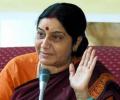
External Affairs Minister Sushma Swaraj will undertake a three-day visit to Bangladesh from June 25 during which she is likely to meet the top leadership of that country.
Bangladesh Prime Minister Khaleda Zia on Friday said she was ready to hand over power to a caretaker government to oversee the general elections due in January.

A special Bangladeshi tribunal on Wednesday sentenced opposition Bangladesh Nationalist Party's 83-year-old leader Abdul Alim to jail until death for committing large-scale killings and other war crimes during the 1971 Liberation War against Pakistan.
Prime Minister Sheikh Hasina slammed her arch-rival Khaleda Zia of the Bangladeshi National Party on Tuesday for spearheading a "misleading campaign" against the $1 billion loan deal with India that has sparked a row between the government and the main opposition party.

It's time India re-visited its Western alliances for the attitude and approach that the West reserves for the nation when it comes to security cooperation of the kind that they might not have visualised outside of China, India's bug-bear, asserts N Sathiya Moorthy.
The four-member Appellate Division bench headed by Chief Justice Surendra Kumar Sinha pronounced the single-word judgement at the tense courtroom.
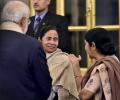
Prime Minister Narendra Modi has positioned himself as a credible partner for Bangladesh. He has scored by getting West Bengal Chief Minister Mamata Banerjee to travel with him to Dhaka, says Srinath Raghavan

The bill to amend the law governing Waqf boards proposes far-reaching changes in the Wakf Act, 1995, including ensuring the representation of Muslim women and non-Muslims in such bodies.
Police opened fire and used tear gas to disperse student groups belonging to the ruling Bangladesh Nationalist Party and its coalition ally the fundamentalist Jamaat-e-Islami party.

More than the jingoism overkill, it's the tedious tone of telling stories of this genre that hurts Pippa, observes Sukanya Verma.
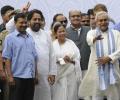
The elections in two eastern Indian states were keenly observed in Bangladesh for two major contentious issues, writes Prakash Bhandari from Dhaka.
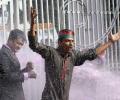
Bangladesh's decision to execute Jamaat-e-Islami chief Motiur Rahman Nizami for war crimes committed in 1971 has provoked anger across the Muslim world. Foreign Secretary S Jaishankar arrived in Dhaka hours after the execution, an important expression of India's support to Prime Minister Sheikh Hasina, explains Rajeev Sharma.

Bangladesh's fundamentalist Jamaat-e-Islami chief Motiur Rahman Nizami was on Wednesday sentenced to death by a special tribunal for his role in the killing of thousands of people during the nation's independence war against Pakistan in 1971.
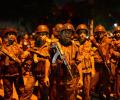
'I have noticed how a certain country wants to establish the presence of ISIS in Bangladesh.' 'Are these terrorists working under some religious inspiration or they are being lured by an obnoxious amount of money?' 'For some mysterious reasons, no action is taken by the government against suspicious organisations.'

About 2 million head of cattle are smuggled into Bangladesh annually.
